Markets and Applications
The Universal Remote Console framework was applied across multiple sectors where accessible, personalized user interfaces make a critical difference.
From its origins in accessibility research at the Trace Center (University of Wisconsin-Madison), the URC standard evolved into a versatile middleware platform relevant to any domain where users interact with networked devices or services. The openURC Alliance and its member organizations demonstrated this versatility through EU-funded research projects, industry prototypes, and real-world deployments across Europe.
Ambient Assisted Living
Europe faces a profound demographic challenge. By 2030, projections indicate that one in four EU citizens will be over 65. The cost of professional care personnel continues to rise, while the number of working-age caregivers declines. Elderly individuals and chronic patients increasingly need continuous health monitoring and assistance with daily activities, yet most prefer to remain in their homes rather than move to institutional care.
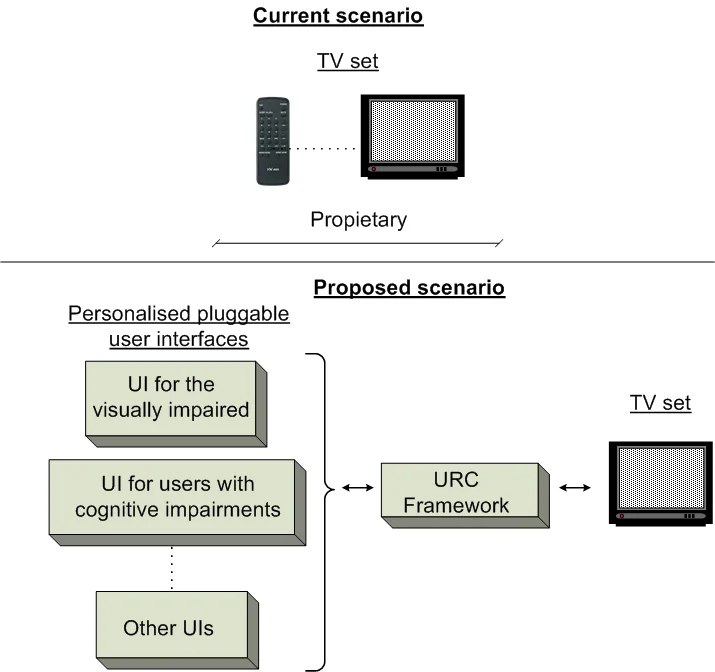
The URC/UCH platform addresses this challenge by connecting home devices and services through a unified, adaptable interface layer. Instead of requiring elderly users to learn separate controls for heating, lighting, medical devices, and communication tools, the Universal Control Hub presents a single personalized interface adapted to each individual's cognitive and sensory capabilities.
This approach was validated extensively in the EU project i2home (FP6, €4.9M, 2006–2009), which tested URC technology with real users in real environments. Evaluations were conducted with Alzheimer patients at the INGEMA day-care center in San Sebastián, Spain; with cognitively impaired youth in Prague, Czech Republic; and with visually impaired participants in Sweden. By the start of 2010, over 100 organizations and companies across Europe were using or evaluating i2home technology.
DFKI developed the SmartCase demonstrator — a fully functional smart home environment packaged in a portable suitcase for trade shows and exhibitions. The SmartCase contained networked appliances (lights, blinds, media player, environmental sensors) all controllable through URC-based interfaces on tablets and smartphones, providing a tangible demonstration of ambient assisted living technology that could travel to conferences, policy meetings, and industry events.
Read more about the i2home project
E-Health
Remote patient monitoring represents one of the most impactful applications of URC technology. By connecting medical devices — blood pressure monitors, glucose meters, pulse oximeters — to the Universal Control Hub, healthcare providers can receive continuous patient data while patients interact with their devices through simplified, accessible interfaces.
Vicomtech, a Spanish research center and openURC Alliance member, developed e-health applications with full URC integration, enabling elderly patients to use complex medical monitoring equipment through intuitive touchscreen interfaces adapted to their visual and cognitive needs.
The VITAL project (FP6, €4.1M, 2007–2010) created the VITAS application suite, a comprehensive platform for delivering health advice, medication reminders, and personalized assistance to elderly users via interactive television. VITAS recognized that the television is the most familiar and least intimidating screen in an elderly person's home, and leveraged URC technology to transform it into a health management terminal. The platform supported seven distinct application modules, from personalized news delivery to simplified video conferencing with healthcare providers.
Read more about the VITAS application suite
Home Automation and Control
The smart home market has long suffered from fragmentation. Dozens of competing protocols — UPnP, Zigbee, Z-Wave, KNX, and proprietary manufacturer solutions — create silos where devices from different vendors cannot interoperate. URC provides the universal interface layer that sits above these protocol differences, presenting users with a unified control experience regardless of the underlying technology.
At CeBIT 2014 in Hannover, the DFKI Competence Center for Ambient Assisted Living demonstrated the Kochbot intelligent kitchen — a prototype smart kitchen where all appliances (oven, hob, extractor fan, refrigerator) were controllable through a single smartphone application built on URC middleware. The Kochbot could guide users through recipes step by step, automatically adjusting appliance settings as the cooking process progressed.
The Universal Control Hub architecture makes this possible by acting as a central gateway. Each appliance exposes its capabilities through a user interface socket description, and the UCH translates between the abstract socket layer and whatever protocol the physical device speaks. Adding a new device to the system requires only a new socket description and a target adapter — no changes to the user interface.
A significant milestone was the development of the Secure UCH, which added authentication, encryption, and access control layers to the Universal Control Hub. Security is critical in home environments where unauthorized access to door locks, cameras, or heating systems poses real safety risks. The Secure UCH demonstrated that the URC architecture could accommodate enterprise-grade security without sacrificing the accessibility and personalization features that define the framework.
Energy
As energy systems become more complex — with renewable sources, battery storage, dynamic pricing, and smart meters — the interfaces that consumers use to monitor and manage their energy consumption must adapt accordingly. Yet energy dashboards are notoriously difficult to use, often presenting dense numerical data and technical terminology that excludes non-expert users.
The URC framework enables accessible energy management interfaces that adapt to user capabilities. A visually impaired user might receive audio summaries of their daily consumption. An elderly user might see a simplified display with large text and clear color coding. A technically sophisticated user might access detailed graphs and historical comparisons. All of these interface variants are generated from the same underlying socket description, ensuring consistency of data while personalizing the presentation.
Smart grid demand response — where utilities request consumers to reduce usage during peak periods — requires clear, timely communication with diverse user populations. URC technology ensures that demand response signals reach all users in a format they can understand and act upon, regardless of disability, language, or technical literacy. The W3C Cognitive Accessibility initiative recognizes URC as a recommended approach for making connected devices accessible to all users.