Overview of the Universal Remote Console Framework
ISO/IEC 24752 defines the Universal Remote Console (URC) — an open standard enabling personalized, accessible user interfaces that can control any networked device or service.
The Problem
Every electronic device ships with its own proprietary interface. A thermostat has a different control paradigm than a washing machine, which differs from a set-top box, which differs from a medical monitor. For most people this is an inconvenience. For persons with disabilities, the elderly, or non-technical users, it becomes a barrier to independence.
The consequences are significant: visually impaired users cannot read small LCD screens, cognitively impaired users cannot navigate complex menu hierarchies, motor-impaired users cannot operate small buttons, and users who speak minority languages find no localization support. Meanwhile, manufacturers have no economic incentive to build specialized interfaces for small populations. The result is a growing gap between technological capability and actual usability.
Proprietary interfaces also prevent interoperability. A user cannot manage their smart home, healthcare devices, and entertainment system from a single personalized interface. Each device exists in its own silo, multiplying the cognitive and physical burden on the user.
The URC Solution
The Universal Remote Console framework solves this by introducing an abstract user interface layer — the user interface socket — that separates what a device does from how it is presented to the user. A socket is an XML description of a device's functions, variables, and commands, independent of any visual or interaction design.
Controllers are the user-facing applications that read socket descriptions and present adapted interfaces. A controller for a blind user might render the socket as speech output; a controller for a cognitively impaired user might present only essential functions with large icons and simple language. Multiple controllers can simultaneously present the same device to different users, each in their own preferred modality.
Targets are the devices and services being controlled. Any networked device that exposes a socket description becomes URC-compatible. The Universal Control Hub (UCH) acts as middleware: it downloads socket descriptions from resource servers, makes them available to controllers, and relays user commands back to targets.
The framework supports multiple wireless communication protocols including WiFi, Bluetooth, and Zigbee. The URC-HTTP binding is designed to be compatible with UPnP, enabling integration with existing home automation ecosystems.
Architecture
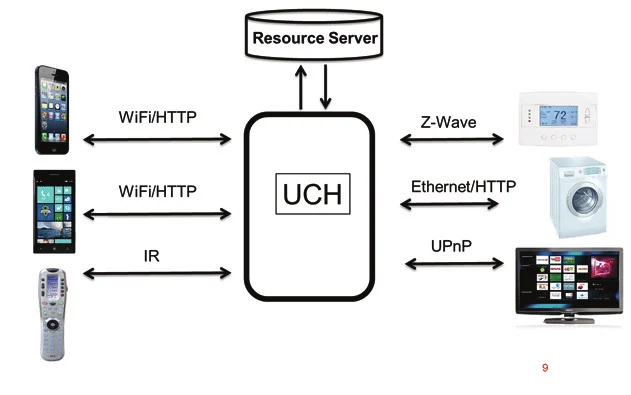
The URC architecture consists of four primary components working together through the UCH middleware layer:
Resource Server
A centralized or distributed server that stores socket descriptions, presentation templates, and user interface resources. Device manufacturers publish their socket descriptions to resource servers, making their products accessible to the entire URC ecosystem. Resource servers can also store localized resources, enabling interfaces in any language without device firmware changes.
Universal Control Hub (UCH)
The core middleware component. The UCH discovers available targets on the network, downloads their socket descriptions from resource servers, and exposes these sockets to connected controllers. It manages sessions, handles protocol translation, and maintains the binding between abstract UI elements and concrete device functions. The UCH runs on a local gateway device — a home server, set-top box, or even a smartphone.
Controllers
User-facing applications that render socket descriptions as personalized interfaces. Controllers can be implemented on any platform: web browsers, mobile apps, dedicated hardware, or assistive technology devices. Each controller adapts the presentation based on the user's profile — their abilities, preferences, language, and interaction modality. A single user might use different controllers in different contexts: voice control while cooking, large-button touchscreen from the couch, switch scanning from a wheelchair.
Targets and Target Adapters
Targets are the devices and services being controlled. Natively URC-compliant targets expose their socket descriptions directly. For legacy devices that predate the standard, Target Adapters provide a translation layer — wrapping proprietary protocols (IR, serial, Z-Wave, KNX) in URC-compatible socket descriptions. This makes the entire installed base of home devices accessible through the URC framework without hardware replacement.
The ISO/IEC 24752 Standard
The full standard — ISO/IEC 24752 — comprises eight parts, published and revised between 2008 and 2018. It is also documented on Wikipedia:
| Part | Title | Published | Status |
|---|---|---|---|
| Part 1 | General framework | 2008, rev. 2014 | Published |
| Part 2 | User interface socket description | 2008, rev. 2014 | Published |
| Part 3 | Presentation template | 2008 | Published |
| Part 4 | Target description | 2008, rev. 2014 | Published |
| Part 5 | Resource description | 2008, rev. 2014 | Published |
| Part 6 | Web service integration | 2014 | Published |
| Part 7 | [Reserved] | — | Reserved |
| Part 8 | User interface resource framework (RESTful) | 2018 | Published |
Open Source
The Trace Center maintained an open source URC Software Development Kit on SourceForge, providing reference implementations that developers could use to build URC-compatible products. The SDK included several key components:
- UCHj — a full Universal Control Hub implementation in Java, suitable for deployment on home gateways, PCs, and embedded Linux devices
- UCH-Android — a UCH implementation for Android devices, enabling smartphones and tablets to serve as control hubs
- Target Adapter Framework — a toolkit for wrapping legacy device protocols in URC socket descriptions
- Easy Target Discovery Module — simplified target discovery for rapid prototyping and testing
These open source tools lowered the barrier to adoption and allowed researchers and small companies to experiment with URC technology without licensing fees.
W3C Recognition
The significance of the URC framework extends beyond ISO standardization. The W3C (World Wide Web Consortium) references URC in its Cognitive Accessibility Roadmap and Gap Analysis, identifying it as a recommended API approach for making the Web of Things accessible to persons with cognitive disabilities. This recognition positions URC as a bridge between the accessibility community and the emerging Internet of Things — ensuring that as devices become smarter and more connected, they also become more usable for everyone.