VITAS — The VITAL Application Suite
VITAS was the main result of the European R&D project VITAL, developing technologies for remote assistance to elderly users through personalized, accessible interfaces.
Objectives
VITAL set out to develop technologies for what the consortium called "Total Assistance" — assistance anytime, anywhere, using any terminal. The project differed fundamentally from traditional remote assistance approaches, which typically focus narrowly on subsistence needs such as emergency alerts and medication reminders.
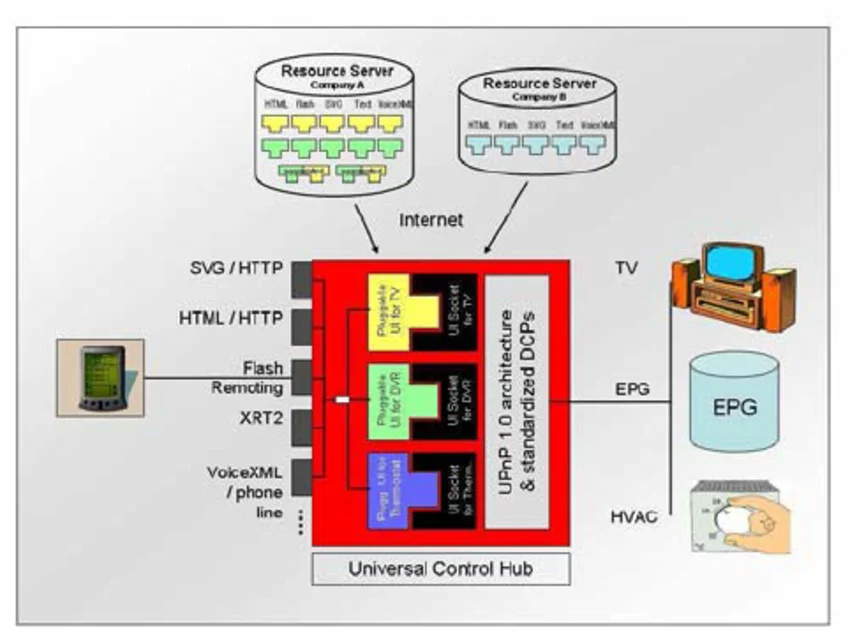
Instead, VITAL aimed to significantly increase the quality of life of elderly users by delivering a comprehensive range of services: advice, assistance, information, education, entertainment, and interpersonal communication. The key insight was that elderly users are most comfortable with terminals they already know — primarily the television and, to a lesser extent, the mobile phone. By building on the URC/UCH platform, VITAL could deliver complex services through these familiar devices while adapting the interface to each individual's capabilities.
Consortium
The VITAL project brought together nine partners from five countries, combining expertise in accessibility technology, gerontology, telecommunications, and natural language processing.
| Partner | Country | Role |
|---|---|---|
| DFKI | Germany | Coordinator |
| Vicomtech | Spain | E-health applications |
| Telefónica I+D | Spain | Telecommunications |
| INGEMA (Instituto Gerontológico Matía) | Spain | Gerontology, user testing |
| CNRS | France | Speech technology |
| Université Paris-Sud XI | France | Natural language processing |
| VECSYS | France | Voice interaction systems |
| Czech Technical University | Czech Republic | Multimodal interfaces |
| Meticube Sistemas | Portugal | UCH implementation |
The VITAS Applications
The VITAS suite comprised seven distinct application modules, each addressing a specific aspect of elderly users' daily needs. All modules ran on the shared URC/UCH platform, ensuring consistent interaction patterns and seamless switching between services.
- Personal Newspaper — Customized news delivery aggregating content from selected sources, presented in large text with audio narration. Users could configure topics, sources, and presentation preferences.
- Information Service — Local information and services including weather forecasts, public transport schedules, pharmacy opening hours, and community events, tailored to the user's location and interests.
- Mobile Tourist Guide — Accessible location-based guidance for elderly tourists and day-trip participants, with simplified navigation, point-of-interest descriptions, and emergency contact information.
- Games — Cognitive stimulation games designed in collaboration with gerontologists at INGEMA, targeting memory, attention, and problem-solving skills while maintaining an enjoyable, non-clinical atmosphere.
- Audiobooks — Accessible audio content delivery with bookmarking, variable playback speed, and integration with public library catalogs, enabling users with visual impairments to access literature independently.
- Education on TV — Learning modules delivered via interactive television, covering topics from health literacy to digital skills, with adaptive difficulty levels and progress tracking.
- Video Conference — Simplified video calling optimized for elderly users, featuring one-touch dialing of pre-configured contacts, automatic camera and microphone adjustment, and large on-screen indicators for call status.
Technology
The entire VITAS suite was built on the URC/UCH platform, with each application exposing its functionality through standardized user interface socket descriptions. This architecture made the platform inherently expandable — adding a new service required only a new socket description and target adapter, with no changes to the controller layer or the user interface framework.
The VITAL consortium identified six primary reference markets for the platform: Healthcare and Ambient Assisted Living, Content and Applications, Entertainment and Education, Social Networks, Telecommunications, and Hospitality. Each market represented a distinct deployment context with specific user requirements, yet all could be served by the same underlying URC architecture.
Meticube Sistemas, the Portuguese partner responsible for the UCH implementation, delivered a production-quality middleware that handled device discovery, session management, and protocol translation between the abstract socket layer and the physical devices and services that each VITAS module required.